
AI Performance in Bing Webmaster Tools: A Complete Guide for SEO & GEO Optimization
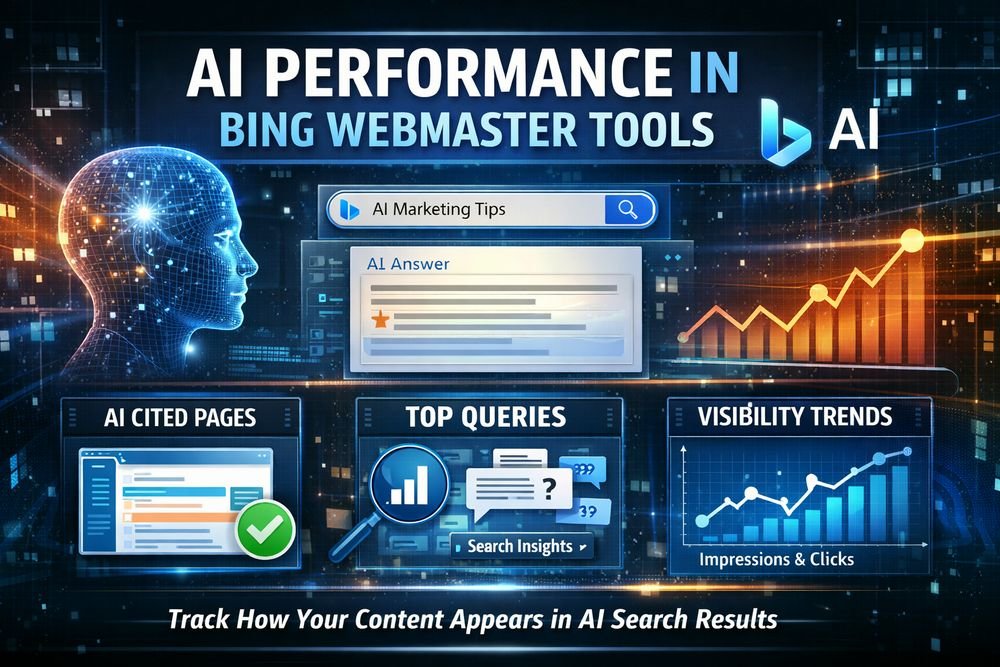
As search evolves beyond traditional blue links, AI-generated answers are becoming a dominant visibility channel. With the rise of AI-powered search experiences, website owners must now optimize not just for rankings but also for citations within AI responses.
That’s where AI Performance in Bing Webmaster Tools becomes essential.
What is AI Performance in Bing Webmaster Tools?
AI Performance is a reporting feature inside Bing Webmaster Tools that shows how your website content is used in AI-generated responses across Microsoft Copilot and Bing search experiences.
Instead of only tracking:
- Clicks
- Impressions
- Keyword rankings
You can now monitor:
- Pages cited in AI answers
- Queries triggering AI responses
- AI-driven visibility trends
- Performance changes over time
This marks a major shift from traditional SEO to GEO (Generative Engine Optimization).
Why AI Performance Reporting Matters
Search engines like Bing are no longer just indexing pages; they are generating answers.
When Bing AI summarizes a topic, it often cites trusted websites as sources. If your page is referenced:
✔ You gain authority
✔ You increase brand exposure
✔ You influence user decisions
✔ You earn high-intent visibility
Even if users don’t click, your brand becomes part of the AI answer ecosystem.
This is visibility beyond rankings.
What Data Does the AI Performance Report Show?
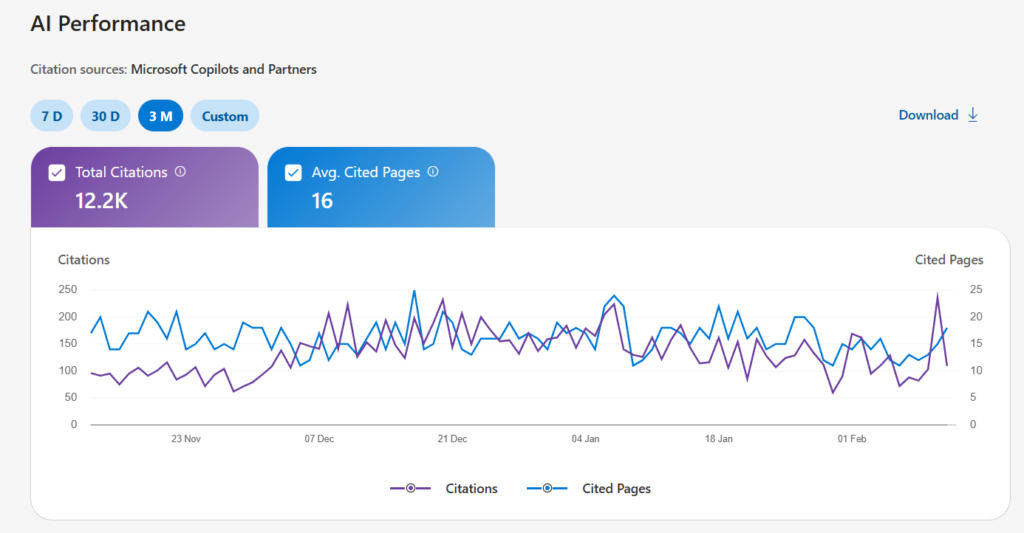
The AI Performance report typically includes:
1️⃣ AI Citations
Which pages from your website were used as references in AI-generated answers.
2️⃣ Associated Queries
Search queries that triggered AI responses including your content.
3️⃣ Visibility Trends
Performance trends over time showing whether your AI presence is increasing or decreasing.
4️⃣ Traffic Signals
Potential impact on impressions and engagement.
This allows marketers to evaluate content influence — not just clicks.
How AI Performance Differs from Traditional SEO Reports
| Traditional SEO | AI Performance Reporting |
| Focuses on rankings | Focuses on AI citations |
| Measures clicks | Measures AI visibility |
| Tracks keywords | Tracks answer-triggering queries |
| Optimizes pages | Optimizes answer structure |
AI Performance introduces a new metric: Answer Authority.
How to Improve AI Performance in Bing
To increase your chances of being cited by AI systems:
1. Structure Content Clearly
AI systems prioritize:
- Clear headings (H2/H3 questions)
- Short definition paragraphs
- Bullet points
- Structured formatting
Example:
Artificial Intelligence (AI) is technology that enables machines to learn from data and automate decision-making processes.
This increases snippet eligibility.
2. Answer Search Intent Directly
AI engines favor:
- Concise explanations
- Fact-based responses
- Question-driven formatting
Use headings like:
- What is AI Performance in Bing?
- How does Bing AI choose citations?
- How can businesses optimize for AI search?
3. Strengthen Topical Authority
AI models cite authoritative, comprehensive content.
Improve authority by:
- Covering related subtopics
- Adding FAQs
- Using semantic keywords
- Publishing consistently
- Building backlinks
4. Use Structured Data (Schema Markup)
Implement:
- FAQ Schema
- Article Schema
- Organization Schema
- Service Schema
Structured data helps AI systems understand context and relevance.
AI Search vs Traditional Search: The Shift to GEO
AI-generated search experiences powered by Microsoft Copilot are transforming how users interact with search results.
Instead of scanning 10 links, users receive:
- Summarized answers
- Contextual recommendations
- Source citations
This means:
Your content must be optimized to be quoted, not just ranked. That is Generative Engine Optimization (GEO).
Benefits of Monitoring AI Performance
Businesses that monitor AI citations gain:
✔ Competitive Intelligence
Identify which content types get cited.
✔ Content Strategy Direction
See what AI prefers and replicate high-performing formats.
✔ Brand Visibility Growth
Increase presence in AI-generated answers.
✔ Early-Mover Advantage
Most businesses still optimize only for traditional SEO.
How to Access AI Performance in Bing Webmaster Tools
- Log in to Bing Webmaster Tools
- Navigate to Performance Reports
- Access AI Performance section
- Analyze cited URLs and triggering queries
- Optimize underperforming content
Strategic Recommendations for 2026 and Beyond
As AI search expands:
- Optimize for conversational queries
- Build expertise-driven content
- Add expert insights and data
- Structure pages for summarization
- Focus on clarity over keyword stuffing
AI systems reward relevance, authority, and structure.
Final Thoughts: The Future of Search Visibility
AI Performance in Bing Webmaster Tools is more than a reporting feature, it’s a preview of the future of search.
Success in modern search requires:
- Traditional SEO
- Technical optimization
- Structured content
- GEO strategy
- AI citation monitoring
Businesses that adapt early will dominate AI-driven discovery.
EchoVision: Your Trusted AI Growth Partner
At EchoVision, we unlock the full potential of AI to help your business:
- Increase efficiency
- Enhance customer engagement
- Optimize marketing ROI
- Drive long-term growth
We deliver tailored AI solutions aligned with your industry, objectives, and digital maturity.
FAQ About AI Performance in Bing
What is AI Performance in Bing Webmaster Tools?
AI Performance is a feature in Bing Webmaster Tools that shows how your website content appears in AI-generated answers on Bing and Microsoft Copilot.
Why is AI Performance important?
It helps you understand whether your pages are being cited in AI responses, increasing your visibility beyond traditional search rankings.
What does the AI Performance report show?
The report displays cited pages, search queries triggering AI answers, and visibility trends over time.
How can I improve my AI visibility on Bing?
You can improve AI visibility by structuring content clearly, answering questions directly, using schema markup, and creating authoritative, well-organized content.
Does AI Performance replace traditional SEO?
No. It complements traditional SEO metrics like clicks, impressions, and rankings by tracking AI-generated answer visibility.